


In cardiovascular surgery, various procedures require inflation devices that must ensure precise control of the pressure and volume of balloons, catheters, and other medical tools during the procedure.
Factors such as maneuverability, precision, speed, and maximum pressure volume are key elements in choosing the most suitable device for each procedure.
The selection of the appropriate inflation device depends on:
- Type of intervention,
- Pressure and time accuracy,
- Balloon volume and repeatability,
- Ergonomics and traceability,
- Compliance with guidelines (e.g., VTE-IPC).
Optimal use of these devices improves hemodynamic control, patient safety, and facilitates clinical documentation. The right choice contributes to better outcomes in cardiovascular treatment.
Procedures requiring an inflator
These are the most common procedures requiring the use of an inflator:
Angioplasty
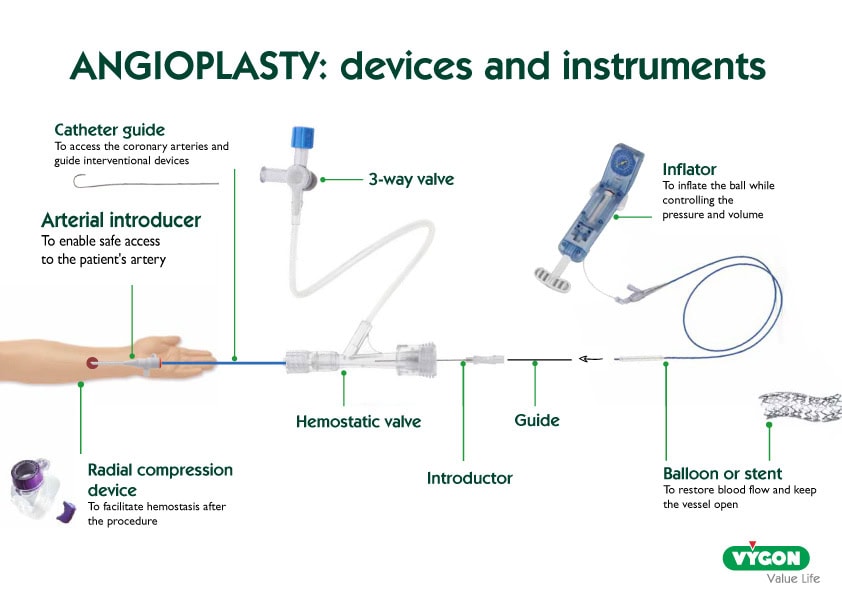
During angioplasty, the narrowed part of an artery is compressed with a balloon catheter that is then inflated using the angioplasty inflation device. The inflation pressure compresses the plaque against the artery walls to restore blood flow. Inflation must be very precisely controlled to avoid damaging the artery. The balloon angioplasty inflation device is used to widen narrowed or blocked blood vessels, especially coronary and peripheral arteries.
Stent deployment
After angioplasty, it may be necessary to insert a stent into the artery to keep it open; there are self-expanding stents or balloon-expandable stents. In the latter case, the stent is expanded using a balloon and a disposable inflation device. The balloon is inflated inside the stent, trapping it against the artery walls to keep the blood vessel open.
Valvuloplasty
During a valvuloplasty, a balloon catheter is inserted through a narrowed valve. The inflation device inflates the balloon, thereby enlarging the valve, increasing blood flow within the heart, and reducing the symptoms of valve stenosis. This procedure is most effective for the mitral and tricuspid valves, as the aortic valve, if too damaged, often requires surgery. The goal of this procedure is to repair a narrowed heart valve.
Clinical indications for the main manual inflators
Inflation devices are critical tools in cardiovascular interventions as they allow control of pressure, volume, and time. The right choice of device influences precision, performance, and safety.
Large-volume inflator with automatic lock:
Ideal for peripheral and coronary angioplasty with large balloons.
Procedures requiring stability and automatic lock for safety.
Compact inflator:
Preferred in coronary angioplasty due to its compact size and speed.
Cramped spaces and need for maneuverability.
High-pressure inflator with optimized unlocking system:
Best suited for complex angioplasties and hypercalcifications (i.e., arteriovenous fistulas or very rigid coronary stenoses).
Most suitable inflator for each procedure
Coronary angioplasty (ICP/ACTP)
Inflation of balloons and balloon-expandable stents.
Recommended device:
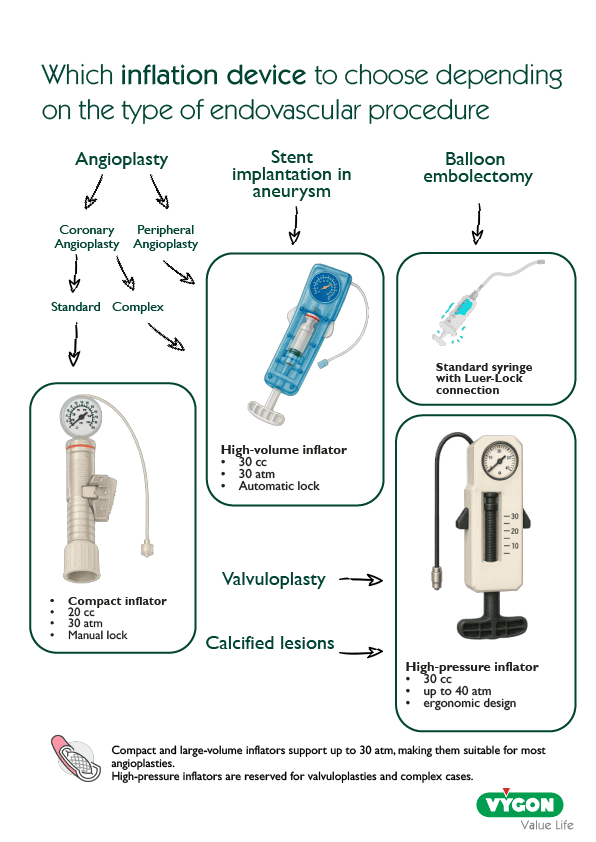
Compact manual inflator → due to its compact size (20 cc), speed, and ergonomics, ideal for coronary angioplasties.
Alternative: Large-volume manual inflator with automatic lock if greater volume or stability is required.
Peripheral angioplasty (PTA)
Larger balloons, greater mixture volume.
Recommended device:
Large-volume manual inflator with automatic lock → 30 cc volume, suitable for large balloons and peripheral procedures.
Valvuloplasty (e.g., aortic valve)
Large balloons, high pressure.
Recommended device:
High-pressure manual inflator with release system, because other inflators only reach 30 atm, which is insufficient for valvuloplasties that require higher pressures.
Endoprosthesis (stent graft) implantation in aneurysms
Controlled inflation for graft fixation.
Recommended device:
Large-volume manual inflator with automatic lock → for volume and stability, although in complex cases a high-pressure system may be required.
Balloon embolectomy (balloon catheter for embolectomy)
Small balloons, moderate pressure.
Recommended device:
Compact manual inflator → sufficient for coronary and small peripheral vessels.
Due to the small volume of the balloon (which is made of latex), it can be inflated simply with a syringe, as this also prevents overpressure that could cause it to rupture.
Angioplasty in renal or carotid arteries
Medium balloons, standard pressure.
Recommended device:
Large-volume manual inflator with automatic lock → larger volume and automatic lock for safety.
Conclusion and practical recommendations
The choice of inflation device depends on the type of procedure, balloon size, and operator preference.
It is important to remember that choosing the right device is a determining factor for safety and efficacy in endovascular procedures. Each procedure has specific requirements in terms of volume, pressure, and ergonomics, so it is essential to adapt the tool to the clinical context.
In summary…
For standard coronary angioplasty, the most suitable option is the compact manual inflator. Its lightweight design and reduced volume (20 cc) make it the ideal choice for coronary balloons, where maneuverability and speed are priorities. In addition, its manual locking system allows for intuitive control during inflation and deflation, optimizing efficiency in routine procedures.
For complex peripheral or coronary interventions with large balloons, a large-volume manual inflator with automatic lock is recommended. With a capacity of 30 cc and a secure locking mechanism, this device offers stability and precision in scenarios that require a larger amount of mixture and prolonged pressure control. Its robustness makes it ideal for larger caliber arteries and for stent placement.
Finally, in valvuloplasties or calcified lesions, where higher than usual pressures are required, the recommended device would be a high-pressure manual inflator for complex angioplasty. Capable of reaching up to 40 atm, these inflators ensure adequate expansion of resistant balloons and success in demanding procedures such as TAVI or valve dilation.
It should be noted that compact, high-volume inflators support up to 30 atm, making them suitable for most coronary and peripheral angioplasties.
Bibliography:
· Gesellschaft für Herzangiographie: Ausschuss für Laborleistungsstandards.
- Richtlinien zu Qualifikationen und Verantwortlichkeiten eines Leiters eines Katheterlabors. Cathet Cardiovasc Diagn, (1983), 9 S. 619-621.
- Gesellschaft für Herzangiographie: Ausschuss für Laborleistungsstandards.
- Richtlinien für die Zulassung von Fachpersonal für Privilegien im Herzkatheterlabor. Cathet Cardiovasc Diagn, (1984), 10 S. 199-201
- Schneidende Ballons vs. Hochdruckballons (2024): Überprüfung, die die Vorteile der Hochdruckangioplastie aufzeigt. [journals.plos.org]
- Adaptive Inflationsgeräte: Aktuelles Patent (März 2025) für intelligente Angioplastie-Inflationssysteme. [patents.google.com]
- Superhochdruckballons: OPN NC ermöglicht eine Aufblasung auf >40 atm mit speziellen Aufblasgeräten für 55 atm. [citoday.com]
- Endovascular Today Device Guide 2023: Technischer Vergleich mehrerer Aufblasgeräte, darunter Presto™, Encore, Caliber und BasixTouch. [evtoday.com], [visionarymedtech.com]