

We are currently living through a pandemic caused by exposure to COVID-19. This infectious disease is caused by the SARS‑CoV‑2 virus, which primarily attacks the respiratory tract, leading to severe pulmonary illnesses.
Since the beginning of the pandemic, invasive therapy has been widely discussed. Recommended for a large number of patients, it aims to treat the effects of the disease on the body through : oxygenation using ventilators, tubes, oxygen, and masks.
However, accessing the airways in order to apply these invasive treatments represents one of the main risks of contamination for healthcare professionals. This is why all international recommendations and COVID‑19–specific guidelines emphasize the need to use devices that facilitate access to the airway. They also make it possible to perform rapid intubation. These devices are bougies and tube exchangers.
These tools are designed to manage difficult airways. Without them, most intubations and the maintenance of endotracheal tubes in hospitals would be impossible. However, their role becomes even more critical in this pandemic context.
THE DIFFERENCE BETWEEN A BOUGIE AND A TUBE EXCHANGER
Bougies are flexible plastic devices that are slightly deformable, cylindrical, hollow or solid, with or without an internal stylet. Thanks to their 45‑degree curved tip, they facilitate access to difficult-to-intubate airways. They can also act as tube exchangers, as they allow patient oxygenation.

The exchange tube, on the other hand, is a long, straight, hollow cylindrical device, with or without a mandrel, used to administer oxygen to the patient. It facilitates the exchange of endotracheal tubes. Unlike a bougie, it cannot be used to intubate the patient because it does not have a 45-degree curved tip.
The role of bougies in ensuring safe intubation during the COVID-19 era
Thanks to their range of sizes, bougies are among on of the most useful devices during this pandemic, enabling successful intubation in all types of patients. In addition, they are perfectly suited to all types of clinical settings, such as:
- Operating rooms
- Intensive care units
- Resuscitation units
- Hospital wards
- Emergency departments
In each of these situations, a bougie is essential whenever difficulty in accessing the airway arises. Relevant authorities recommend their use:
“Plan for the use of an intubation guide.” Protocol for the clinical management of patients with a novel coronavirus disease (COVID‑19)”, issued by the Ministry of Health.

“When faced with a difficult airway, a video laryngoscope should be used as the intubation device, preferably with a hyper‑angulated blade. The use of an intubation guide should also be considered.” Recommendations of the Spanish Society of Anaesthesiology, Critical Care and Pain Management for airway management in patients infected with coronavirus.

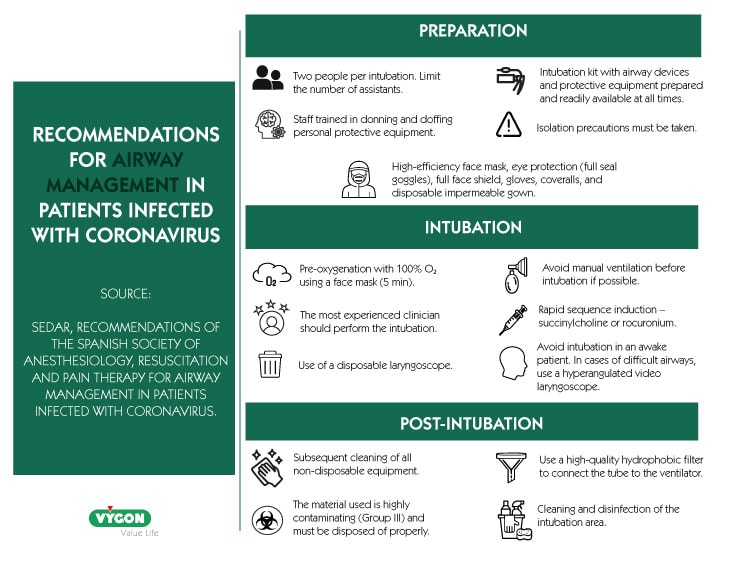
INTUBATION GUIDES DURING CARDIOPULMONARY RESUSCITATION IN THE CONTEXT OF COVID‑19
The role of these devices in emergency departments is particularly significant. Emergency teams are sometimes overlooked. There may be a perception that COVID‑19 is only present in hospital emergency rooms and intensive care units. However, early treatment of this disease outside the hospital setting is essential in order to limit the effects of the virus.
Furthermore, in the case of a patient in cardio‑respiratory arrest during the COVID‑19 period, the value of intubation guides for emergency teams is fundamental. Dr José Ignacio Garrote and Dr Boussignac developed protocols for performing cardiopulmonary resuscitation during the COVID‑19 pandemic.
In addition, many recommendations issued by scientific societies even state that bougies should be considered the first‑line intubation option during cardiopulmonary resuscitation when COVID‑19 is suspected. This recommendation also applies when the patient is confirmed to be COVID‑19 positive. Only in this way can rapid, efficient, and effective intubation be ensured, while minimizing contact between the healthcare professional and the patient’s airway.
Recommendations on CPR in the context of COVID-19
Let us now review the modifications made to CPR guidelines during the COVID‑19 pandemic that affect airway management, in which bougies play a crucial role :
- After healthcare personnel have assessed the rhythm and defibrillated any ventricular arrhythmia, patients in cardiac arrest should be intubated with a cuffed endotracheal tube as soon as possible. The endotracheal tube should be connected to a ventilator with a HEPA filter, if possible. Interim Guidance for Basic and Advanced Life Support in Adults, Children, and Neonates With Suspected or Confirmed COVID-19 , published by the American Hear Association.

- Airway management should be performed by the most experienced provider. Orotracheal intubation should be carried out as soon as possible using a video laryngoscope with a separate monitor (to allow the greatest possible distance from the patient). The use of a smaller endotracheal tube mounted on an intubation guide (“Frova”) is recommended. These two measures significantly increase the success rate of first‑attempt intubation. If the first attempt fails, a supraglottic airway device (SAD) should be inserted. A filter should then be placed directly on the endotracheal tube or the SAD to protect against infection. Recommendations for cardiac arrest management during the COVID‑19 pandemic from the Catalan Resuscitation Council.

If you wish to learn more about protocols, new recommendations, and perspectives on cardiopulmonary resuscitation in the era of COVID‑19, you can consult the interview with Dr José Ignacio Garrote, emergency physician at SESCAM, available here.
THE IMPORTANCE OF COMPLYING WITH REGULATIONS ON SINGLE‑USE MEDICAL DEVICES
We previously discussed the new European regulation governing the reprocessing of single‑use medical devices, Regulation (EU) 2017/745 of the European Parliament and of the Council of 5 April 2017 on medical devices. The objective of this regulation was to prevent the risks posed to patients by the reprocessing of certain products.
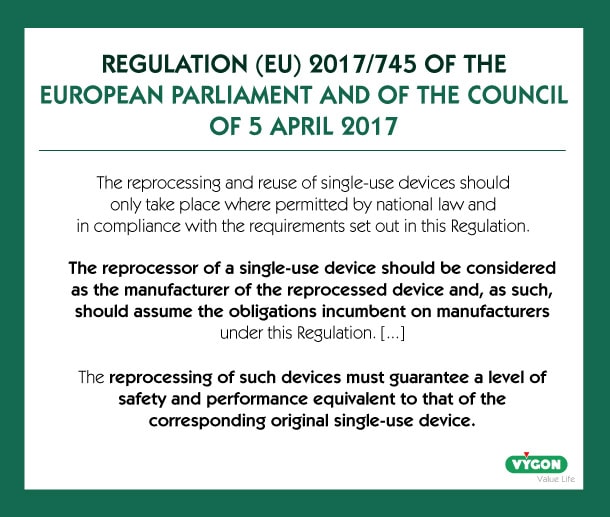
Today, in the context of the global pandemic, many will better understand why the European Union decided to be so strict on this matter. Indeed, numerous guidelines and recommendations from health authorities refer to the use of disposable products whenever possible and, when this is not feasible, to the strict application of all specific cleaning and sterilization protocols.