

For many years, perioperative and critical care medicine has moved towards a simple but powerful idea: we should not treat physiology blindly.
In adult patients, advanced hemodynamic monitoring and tissue perfusion assessment have helped shape what we now call Goal-Directed Therapy. The principle is clear: when cardiac output, oxygen delivery and perfusion are monitored and optimized according to explicit goals, clinical decisions become more precise, more proactive and, ultimately, more patient-centered.
This concept has been widely explored in adult high-risk surgical patients. Studies such as those by Hamilton1 and many others have shown that perioperative optimization of global blood flow can reduce complications and improve outcomes.
But when we move into pediatrics, the discussion becomes even more relevant.
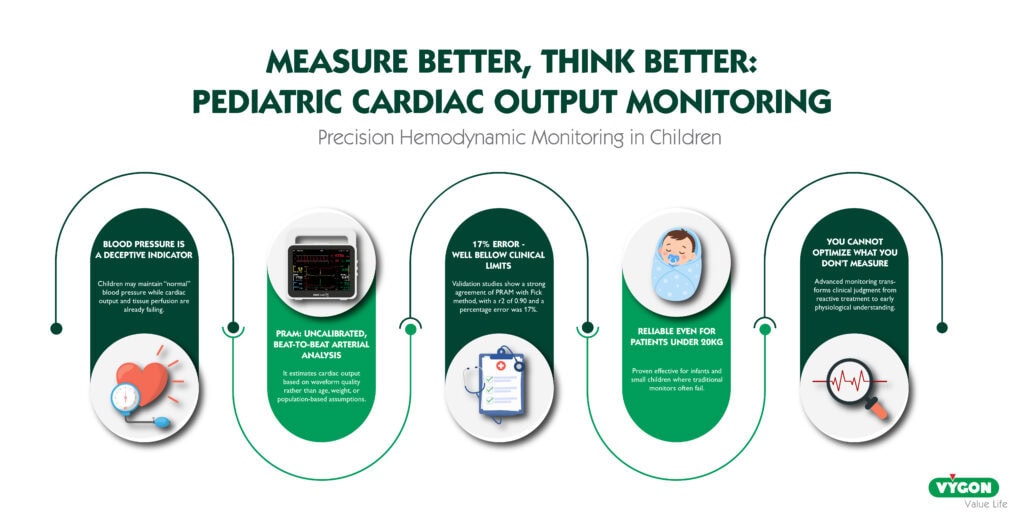
Children are not simply “small adults”. Their cardiovascular physiology is dynamic, adaptive and sometimes deceptively silent. A child may maintain blood pressure until very late in the course of cardiovascular deterioration. Heart rate and blood pressure may look acceptable while cardiac output and tissue perfusion are already compromised.2

This is what makes pediatric hemodynamics both fascinating and dangerous.
The margins are narrower. The reserves are smaller. The clinical signs may appear late. And the anesthesiologist or intensivist is often forced to make critical decisions with incomplete information.
For a long time, one of the major obstacles to pediatric Goal-Directed Therapy has not been the lack of physiological rationale. It has been the lack of reliable, feasible and validated monitoring tools for children, especially for infants and younger patients.
Many cardiac output monitors were developed for adult physiology and then adapted to pediatric patients with variable success. Some depend on nomograms, anthropometric assumptions or repeated calibrations. Others become technically difficult, unreliable or clinically impractical in small children.
This is why the Pressure Recording Analytical Method, or PRAM®, is particularly interesting.3, 4
PRAM® does not rely on external or internal calibration. It does not require population-based estimations of vascular impedance. Instead, it performs a beat-to-beat mathematical analysis of the arterial pressure waveform. In practical terms, its performance depends mainly on the quality of the arterial pressure signal, rather than on the child’s age, weight or body surface area.
That idea was the basis of our research question:
Could PRAM® provide a reliable estimation of cardiac output in pediatric patients?
To answer this, we designed a prospective, single-center, observational validation study in children undergoing diagnostic right and left heart catheterization. This setting was particularly valuable because it allowed us to compare PRAM® against the Fick method, traditionally considered a reference method for cardiac output estimation.5
The study included pediatric patients from birth to 14 years of age scheduled for routine diagnostic cardiac catheterization. Cardiac index measurements obtained with MostCare-PRAM® were compared with cardiac index measurements obtained using the Fick principle.
A key strength of the design was that measurements were performed under carefully controlled hemodynamic conditions. We only accepted measurements when the patient was stable, avoiding relevant fluctuations in mean arterial pressure, oxygen saturation, central venous pressure and oxygen consumption. This was essential because the aim was not simply to collect numbers, but to test whether both methods were truly comparable under reliable physiological conditions.
The arterial pressure waveform was carefully assessed. Since PRAM® depends on the quality of the arterial pressure signal, over-damped or under-damped traces were specifically evaluated and corrected when possible. Patients with persistent poor signal quality were excluded. This point is important: PRAM® is not magic. It is physiology and mathematics applied to a high-quality arterial signal.
The Fick cardiac output measurement was also performed rigorously. Oxygen consumption was measured, arterial blood was sampled from the femoral artery, and mixed venous blood was sampled from the pulmonary artery. PRAM® and Fick measurements were obtained simultaneously over a three-minute period, reducing the risk of comparing two different hemodynamic moments.
This methodological detail matters
One of the common problems in cardiac output validation studies is that two methods may be compared sequentially rather than simultaneously. In children, where hemodynamic conditions can change rapidly, even a short delay may introduce clinically relevant bias. By acquiring PRAM® and Fick data at the same time, the study aimed to compare both techniques within the same physiological window.
The results were clinically meaningful
Across 40 paired measurements, PRAM® Cardiac Index showed a strong agreement with Fick method, with a r2 of 0.90 The mean bias was very low (-0.075), and the percentage error was 17%, well below the commonly accepted 30% threshold for interchangeability between cardiac output methods.
Importantly, similar results were observed in children weighing less than 20 kg, a subgroup where many hemodynamic monitors become less reliable or clinically impractical. In these smaller patients, PRAM® again showed good agreement with Fick, with a percentage error of 17%. (Pediatric Anesthesia)5.
This was not just a technical result
It suggested that an uncalibrated pulse contour method could estimate cardiac output in children with a level of agreement compatible with clinical use, provided that the arterial pressure waveform is reliable.
For me, the key message goes beyond one monitor or one study.
The real message is that pediatric hemodynamic management must evolve from reactive treatment to physiological understanding.
We should not wait for hypotension to recognize circulatory failure.
We should not assume that normal blood pressure means adequate perfusion.
We should not accept uncertainty when better information is available.
Advanced hemodynamic monitoring is not about replacing clinical judgment. It is about improving it.
And validation studies matter because they are the bridge between an attractive physiological concept and responsible clinical use.
In pediatrics, this bridge is especially important. We cannot simply import adult technologies and assume they will perform adequately in infants, toddlers or children with congenital heart disease. We need pediatric data. We need pediatric validation. We need to understand not only what a monitor measures, but also when it can be trusted and under which conditions it may fail.
That is why cardiac output monitoring in children is not only a technical issue.
It is a clinical mindset.
Because in pediatric anesthesia and intensive care, excellence does not come from treating numbers.
It comes from understanding physiology early enough to change the trajectory of the patient.
“You cannot optimize what you do not measure.
And in children, measuring better means thinking better”
PRAM® and MostCare® are trademarks of Bio-Si International s.r.l.
References
- Hamilton MA, Cecconi M, Rhodes A. A systematic review and meta-analysis on the use of pre-emptive haemodynamic intervention to improve postoperative outcomes in moderate and high-risk surgical patients. Anesth Analg. 2011;112(6):1392-1402.
- Sinha R, Nadel S. Understanding shock. Paediatrics and Child Health. 2013;23(5):187–193.2-Waltzman ML. Pediatric Shock. Journal of Emergency Nursing. 2015;41(2):113–118.
- Romano SM, Pistolesi M. Assessment of cardiac output from systemic arterial pressure in humans. Crit Care Med. 2002 Aug;30(8):1834-41. doi: 10.1097/00003246-200208000-00027. PMID: 12163802.
- Romagnoli S, Franchi F, Ricci Z, Scolletta S, Payen D. The Pressure Recording Analytical Method (PRAM): Technical Concepts and Literature Review. J Cardiothorac Vasc Anesth. 2017 Aug;31(4):1460-1470. doi: 10.1053/j.jvca.2016.09.004. Epub 2016 Sep 14. PMID: 28012725.
- Alonso-Iñigo JM, Escribá FJ, Carrasco JI, Fas MJ, Argente P, Galvis JM, Llopis JE. Measuring cardiac output in children undergoing cardiac catheterization: comparison between the Fick method and PRAM (pressure recording analytical method). Paediatr Anaesth. 2016 Nov;26(11):1097-1105. doi: 10.1111/pan.12997. Epub 2016 Aug 27. PMID: 27565740.