
According to the joint guidelines of the World Health Organization and the International Labour Organization (WHO/ILO, 2022), a Needlestick and Sharps Injury (NSI), which falls within the broader category of Bloodborne Exposure Incidents (BEI), is defined as an occupational exposure characterised by a percutaneous injury (needlestick, cut) or contact of a mucous membrane or broken skin with blood or other potentially infectious biological fluids.
Far from being an inevitable occupational hazard, NSIs represent a major public health and occupational safety challenge on a global scale.
| 3M / YEAR WORLDWIDE | 55,000 REPORTED / YEAR IN FRANCE* | 44.5% OF HOSPITAL NSIs | > 80% PREVENTABLE |
| Percutaneous exposures among healthcare workers (WHO, 2003) | In healthcare facilities (RAISIN/SPF, 2024) | Occur during nursing procedures (GERES/CPIAS, 2023) | With appropriate safety medical devices (CDC, 2024) |
Act 1 — Epidemiology: A Global Burden in Numbers
Every year, according to the WHO and the international EPINet network (2024), NSIs are a major source of chronic illness among healthcare workers. These exposures historically result in the following infections worldwide:
- 66,000 hepatitis B (HBV) infections
- 16,000 hepatitis C (HCV) infections
- 1,000 HIV infections
A healthcare worker sustains between 0.2 and 4.7 injuries per year depending on the country and discipline (WHO, 2003). Among nurses, more than 80% of these incidents are needlestick injuries (GERES, 2023).
These figures raise a question of collective responsibility: if the majority of these accidents are preventable, their persistence can no longer be considered inevitable.
Act 2 — Immediate Response to an NSI
The emergency protocol exists. However, applying it correctly under stress is challenging, and the slightest error can have serious consequences.
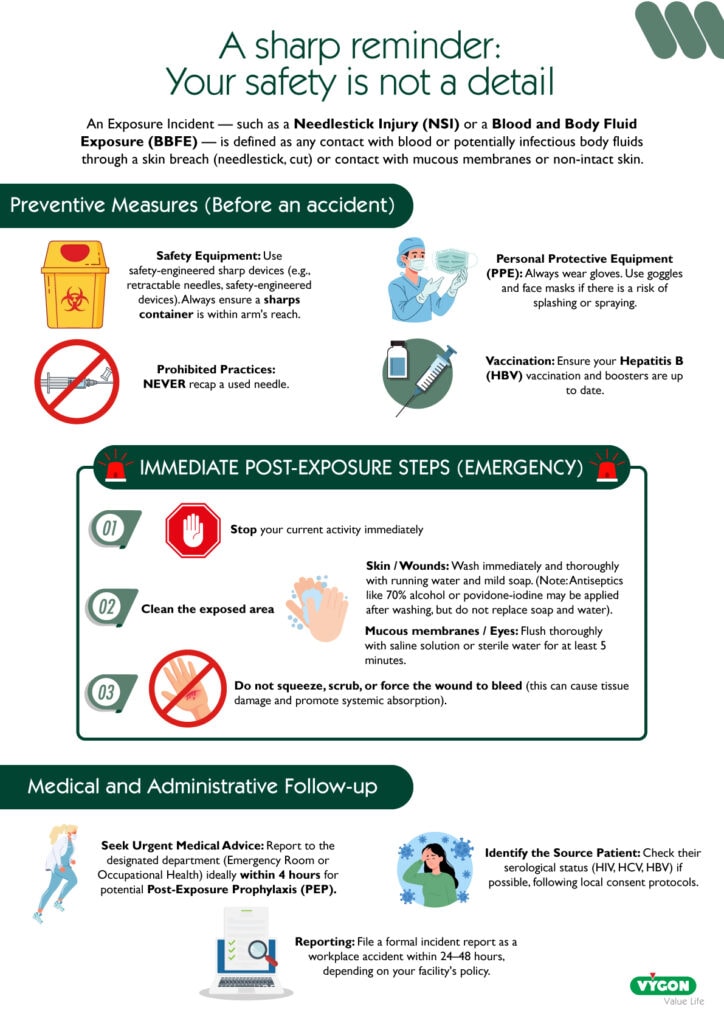
- Stop the current activity immediately. Continuing the procedure increases the risk of contamination and delays appropriate management.
- Wash the exposed area immediately:
- Skin and wounds: Wash with running water and mild soap, then rinse thoroughly. Never squeeze the wound — pressing the tissue creates a suction effect that promotes systemic absorption of the pathogen (INRS ED 6140, 2019).
- Mucous membranes and eyes: Flush abundantly with saline solution or clean water for at least 5 minutes.
- Decontaminate: Apply antiseptic by soaking or direct contact for at least 5 minutes (Dakin solution, povidone-iodine, or 70% alcohol). The antiseptic does not replace the initial soap-and-water wash (refer to the local unit protocol).
- Seek urgent medical attention within 4 hours: attend the designated service (Emergency Department or Occupational Health). This timeframe is a strict medical requirement for the potential administration of Post-Exposure Prophylaxis (PEP). Beyond this window, the efficacy of prophylaxis decreases significantly. After 48-72 hours post-exposure, the literature no longer demonstrates meaningful protective benefit (HAS, 2024).
- Identify the source patient (HIV, HCV, HBV status) in accordance with local consent protocols, then formally report the occupational accident to your employer within 24 hours.
Post-Exposure Kit: Acting Without Improvisation
The quality of an immediate response depends as much on organisation as on training. Having a dedicated post-exposure kit readily available at the point of care ensures that the correct actions can be taken without improvisation — regardless of context, time of day, or the healthcare worker’s level of experience.
Act 3 — The Psychological Injury: The Invisible Impact
Statistical and epidemiological data capture only a fraction of the real consequences of an NSI. Beyond the purely infectious risk, the most underestimated dimension is psychological — and it affects all healthcare workers, with heightened vulnerability among early-career professionals and those in training (nursing students, junior doctors).
Added to this vulnerability is a persistent anxiety: PEP efficacy is not 100% (GERES, 2024), leaving a lingering psychological uncertainty despite treatment. Waiting for the source patient’s serological results, the prospect of follow-up extending to 12 weeks, the fear of infecting loved ones, and the side effects of a 30-day antiretroviral regimen all constitute a burden that statistics do not record.
This psychological toll, documented by Green & Griffiths (2013), is recognised as a contributing factor to professional burnout. It extends well beyond the physical injury, and in cases requiring PEP, it is accompanied by sick leave that further burdens already overstretched teams. This is where the human cost becomes a systemic cost.
Act 4 — Prevention: Ensuring Safety in Clinical Settings
Prevention begins with two non-negotiable imperatives: up-to-date hepatitis B vaccination (which effectively protects the healthcare worker) and the absolute prohibition on recapping used needles (European Directive 2010/32/EU) — a practice still responsible for preventable NSIs today.
In day-to-day practice, the first physical barrier remains the systematic use of Personal Protective Equipment (PPE).
Gloves are mandatory, with a strong recommendation for double-gloving when caring for patients with a known serological status (SF2H, 2017): passing a needle through two layers mechanically wipes away a significant portion of the contaminating blood.
Masks and eye protection are essential during any procedure with a risk of splashing or aerosolisation to prevent mucosal exposure (eyes, mouth).
Ultrasound guidance: clinical practices are also evolving — the increasing use of ultrasound guidance for vascular access is becoming a major preventive tool. By visualising the vascular target, the practitioner secures the procedure, reduces the number of attempts, and dramatically decreases the risk of accidental NSI (INS Standards, 2024).
However, large-scale data from the GERES network (NSI Surveillance 2019–2023) yield a clear finding: the incidence of NSIs among nurses has plateaued. Conventional safety systems — which rely on voluntary action by healthcare workers — have reached their efficacy ceiling.
A GERES comparative study on incidence rates per 100,000 devices illustrates this unambiguously:
- Sliding shield system (manual): 5.20
- Push-button system (semi-automatic): 1.18
- AUTOMATIC system: 0.06
An automatic device is statistically 86 times safer than a manual device and 20 times safer than a semi-automatic system. Accordingly, for catheter insertion procedures, the integration of passive/automatic safety devices reduces the overall risk of NSI by an average of 74%.
Act 5 — The True Cost of a BEI
Safety has a price. Insecurity has a far higher one. Even in the absence of infection, the real cost of a BEI far exceeds local wound care. It encompasses emergency medical time, biological testing for both the healthcare worker and the source patient, and enhanced follow-up.
| €400 – €1,000 Average cost of a BEI without complication (European Biosafety Network, 2022) | ~ €5,000 Estimated cost when PEP is indicated, including enhanced follow-up and full management (INRS, ED 6140, 2019) |
| ~ $5,000 Per incident in the United States (Daniels Health, 2024) | ~ £10.8M Paid in NSI-related compensation (NHS Resolution, 2012–2022) |
These figures reframe the situation: the apparent additional cost of an automatic device is marginal compared to the real, recurring, and structural cost of inaction.
Beyond these direct financial costs lies an amplification dynamic that raw figures fail to capture. According to GERES and the COREVIHs (2023), approximately 10% of occupational BEIs require the prescription of Post-Exposure Prophylaxis (PEP).
PEP is not a trivial treatment: it consists of a strict daily triple-therapy regimen over 30 days, with a very narrow initiation window. Sick leave resulting from the psychological shock of the incident or from the significant side effects of this protocol deprives the facility of valuable staff, deepening a workforce deficit that scheduling is already struggling to absorb.
PEP adverse effects are frequent and well documented, particularly in the early stages of treatment (CRPV, HAS 2024). They may compel the healthcare worker to reduce or suspend their activity for a period ranging from a few days to several weeks.
The impact on the unit operates simultaneously on two levels, creating a genuine organisational double burden: the facility first bears the direct cost of the BEI, then the cost of the resulting absence. This induced disruption to the team — improvised replacements, overtime, redistributed workload — represents an avoidable burden for incidents that available technology could largely prevent.
Conclusion: Aligning Our Equipment with Our Safety Ambitions
NSIs represent a substantial mental, clinical, and economic burden for a healthcare system already under strain.
Protocols exist. Devices are available. The data have been known for years. The current challenge is no longer one of knowledge acquisition, but of systematic deployment of preventive solutions.
As long as safety depends on voluntary action in a high-pressure environment, residual risk persists. Aligning tools with ambitions means acknowledging that prevention cannot indefinitely rest on human vigilance alone.
Technology is here. Its widespread adoption is the logical next step.
About the Clinical Contributor
This article was developed with the clinical expertise of Jérôme Paniego, Nurse Anesthetist and Vascular Access Unit (VAU) Coordinator at the Clinique du Millénaire (Montpellier, France). He is also a standing member of the scientific committee of GIFAV (French Group for Innovation and Training in Vascular Access).
Sources and Scientific References
Institutions and Epidemiological Data
- WHO (World Health Organization) (2003, 2022): Guidelines on Drawing Blood: Best Practices in Phlebotomy & Managing occupational exposure to hepatitis B, hepatitis C and HIV / Sharps injuries: Global burden of disease from sharps injuries to health-care workers.
- GERES & CPIAS (2023–2024): NSI Surveillance 2023 (National RAISIN network data, 2024) & Incidence data by type of safety device.
- GERES / COREVIH (2023): National surveys on NSI management and PEP prescriptions (2019–2023).
- CDC (Centers for Disease Control and Prevention) (2024): Updated U.S. Public Health Service Guidelines for the Management of Occupational Exposures to HIV and Recommendations for Postexposure Prophylaxis & Sharps Safety for Healthcare Settings.
- International Safety Center (2024): EPINet Report for Blood and Body Fluid Exposures.
Prevention, Protocols, Occupational Health and Standards
- INRS (Institut National de Recherche et de Sécurité) (2019): Immediate response to needlestick and sharps injuries (Poster A 775) & Prevention guide (ED 6140).
- INRS (2023): Personal protective equipment — biological risks & Gloves and biological risks: a crucial role in safety.
- OSHA (Occupational Safety and Health Administration) (2001): Bloodborne Pathogens Standard (29 CFR 1910.1030).
- European Union (2000, 2010): Council Directive 2010/32/EU and Directive 2000/54/EC.
- Ministère du Travail / 3RB (2008): Fiche Prévention : Accidents exposant au sang (AES) et leur prévention.
- SF2H (French Society for Hospital Hygiene) (2017): Recommendations on NSI prevention and PPE use.
- INS (Infusion Nurses Society) (2024): Infusion Therapy Standards of Practice — Ultrasound guidance recommendations.
- HAS (Haute Autorité de Santé) / CNS / ANRS-MIE (2024): HIV post-exposure prophylaxis — Clinical practice guidelines, July 2024.
Economic and Psychological Impact (TCO)
- INRS (2019): Research and studies: Cost assessment of NSIs.
- Daniels Health (2024): The Cost of a Needlestick Injury (2024/2025 Report).
- BD IV News (2023): What is the financial cost of preventable needlestick injuries?
- NHS Resolution (2023): Needlestick injury claims data 2012–2022 — Annual report and accounts & Launch of resources on preventing needlestick injuries.
- European Biosafety Network (2022): Cost-benefit analysis of safety-engineered medical devices.
- Green, B., & Griffiths, E. C. (2013): Psychiatric consequences of needlestick injury (Occupational Medicine).
Equipment and Technical Standards (PPE)
- Infirmiers.com (2020): Des gants chirurgicaux capables de réduire le risque d’accident d’exposition au sang (Profession IDE).
- PubMed / Cochrane Database (2014): Gloves, extra gloves or special types of gloves for preventing percutaneous exposure injuries in healthcare personnel & Needlestick.
- Current Industry Standards (2016, 2020): NF EN 455 Standard (Single-use medical gloves) and ANSI/ISEA 105-2016 Standard (Needle puncture resistance assessment).