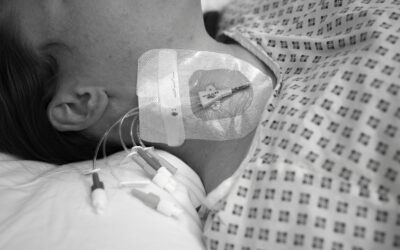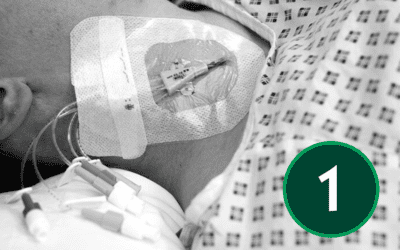

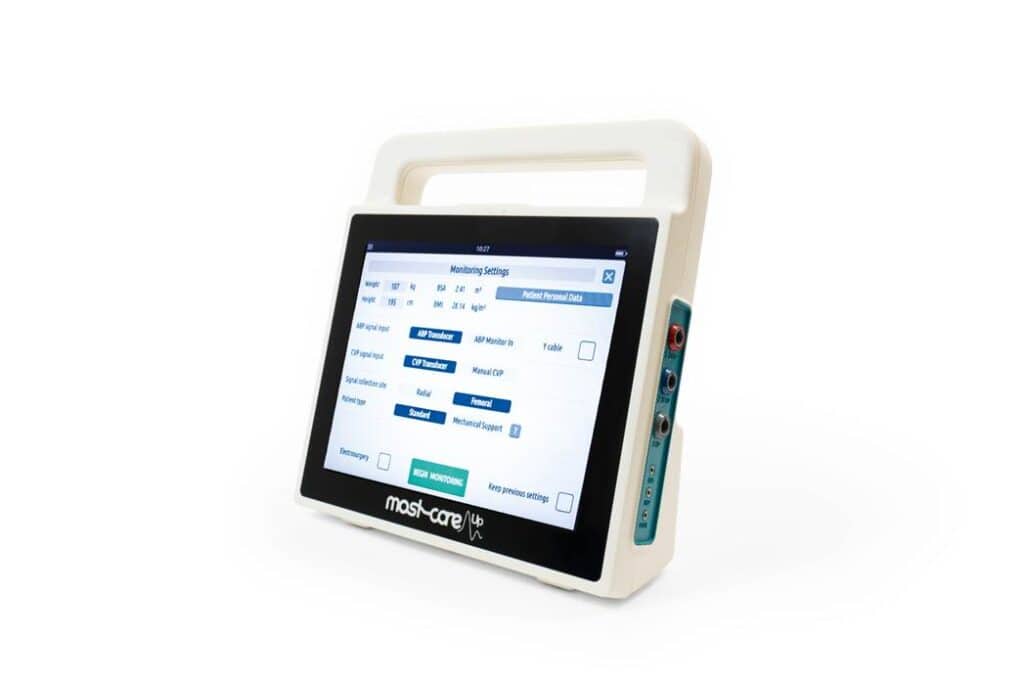
This is an example of setting up a Mostcare Up device.
Accurate haemodynamic monitoring is fundamental in critical care and choosing a device which gives clinicians access to real‑time, beat‑to‑beat data that can guide timely, lifesaving decisions is crucial to improving patient outcomes. The quality of that information depends entirely on correct set‑up. A properly connected and zeroed transducer ensures that the arterial waveform is clean, reliable, and physiologically accurate. This means clinicians can act with confidence when managing complex situations such as shock, fluid resuscitation, vasoactive therapy, or assessing cardiac function.
Critical care teams need technology that’s easy, reliable, and accurate. The simplicity and speed of the cardiac output monitor’s set‑up process could reduce the clinicians cognitive load and minimises delays.
When the system is prepared correctly from the start, clinicians gain immediate access to dynamic parameters that reflect the patient’s true circulatory status, without waiting for invasive procedures or intermittent measurements. In fast‑moving environments, that ability to see meaningful change in real time supports safer care, earlier interventions, and better outcomes.
Finding a cardiac output monitor that is designed with exactly that in mind – delivering real‑time, beat‑to‑beat haemodynamic data with a set‑up process that takes just three straightforward steps is important.
Why This Set‑Up Matters for Clinicians
Setting up a cardiac output monitor correctly is essential because the accuracy of all haemodynamic parameters depends on the quality of the arterial waveform the device receives. Even slight errors in connection or zeroing can distort the trace, leading to misleading values. Ensuring the system is connected, configured, and zeroed properly means clinicians can trust the data from the very first reading, making these three set‑up steps critical to reliable monitoring.
Setting Up a Cardiac Output Monitor: As Easy as One, Two, Three…
Setting up a cardiac output monitor is a crucial first step in generating reliable haemodynamic information, and the process should be simple. Before any analysis can take place, the monitor must receive a clean, undistorted arterial signal, something that depends entirely on careful connection, accurate patient data entry, and precise transducer zeroing.
By approaching the set‑up methodically, clinicians create the conditions needed for dependable, beat‑to‑beat analysis right from the start. With cardiac output monitors such as Mostcare Up, these foundational tasks have been streamlined into three clear steps, ensuring that high‑quality haemodynamic data is only moments away.
Step One: Connect Mostcare Up
Before haemodynamic analysis can begin, cardiac output monitors rely entirely on a clean, correctly calibrated arterial signal. Proper set‑up ensures that the waveform is transmitted without damping, interference, or baseline drift. That’s why following the three set‑up steps precisely, connecting the system, entering patient information, and zeroing the transducer is essential. When these steps are completed accurately, clinicians can be confident that the values they see reflect the patient’s true circulatory status.
Connecting a monitor that integrates seamlessly with standard bedside monitors, depending on your clinical environment, can be achieved in one of two ways:
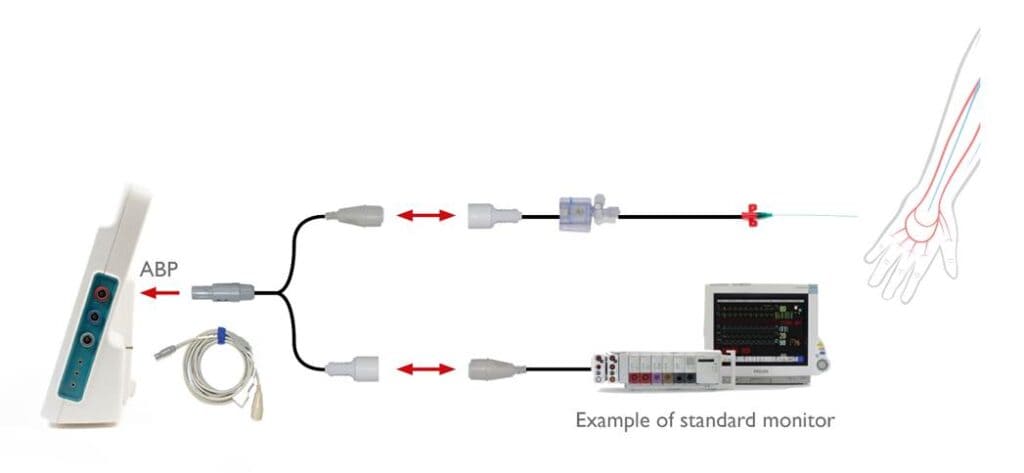
Option 1: Y Cable
Connect the Y cable between the bedside monitor and the arterial blood pressure (ABP) transducer.
This allows the signal to be shared between the primary monitor and the cardiac output monitor without disruption.
Option 2: Analogue Cable
Alternatively, the analogue cable can be connected directly between the cardiac output monitor and the bedside monitor.
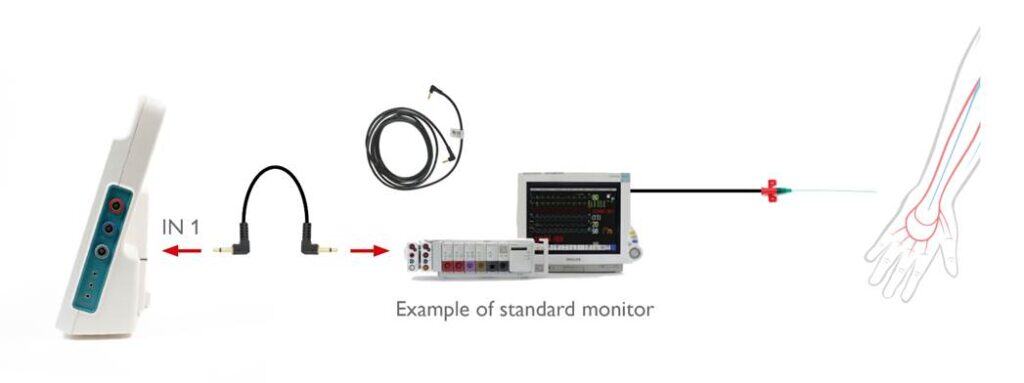
Both routes ensure a clear, stable ABP waveform essential for accurate analysis.
This part of the process is designed to be quick: simply connect, verify the signal, and you’re ready to move on to the next step.
Step Two: Enter the Patient Data
Once your signal is established, you are then prompted to enter the patient data you have available, this includes:
- Patient weight
- Patient height
- Type of ABP transducer
- Whether a Y cable is being used
These details allow the algorithm to tailor analysis to the patient’s physiology. Once everything is confirmed, the platform will initialise the monitoring session.
Step Three: Zero the Transducer
Accurate haemodynamic measurements depend on precise transducer zeroing. The process is simple:
- Position the transducer at the level of the phlebostatic axis – the anatomical point that aligns with the right atrium.
- Open the transducer stopcock to air so atmospheric pressure can be measured.
- On the screen, touch the arterial trace and select Zero ABP.
- Zero the primary bedside monitor as well, then re‑establish the waveform.
Once zeroed, the system immediately begins delivering continuous, beat‑to‑beat analysis – including stroke volume, cardiac output, systemic vascular resistance, and more.
 Building Accuracy from the Start
A cardiac output monitor’s beat‑to‑beat analysis is only as good as the arterial trace it receives, which makes correct set‑up a clinical priority rather than a technical one. If the transducer is positioned incorrectly, if zeroing is incomplete, or if the waveform is not transmitted cleanly, the system cannot deliver reliable haemodynamic data. By taking a moment to complete these three key set‑up steps with precision, clinicians ensure that every parameter displayed has a trustworthy foundation.
Why Choose a System Designed for Real‑Time Decision Support
Choosing a cardiac output monitor which removes complexity in the first stages enables clinicians to focus on patient care rather than equipment. With rapid set‑up, intuitive prompts, and high‑fidelity arterial waveform analysis, the platform supports faster, more confident haemodynamic decision‑making at the bedside. If your team would benefit from further training, hands‑on demonstrations, simulations, or support materials, Vygon offers a full suite of resources to help you get the most from this technology.
Conclusion
Setting up an advanced cardiac output monitor should never be a barrier to delivering timely, informed care, and with systems designed for simplicity, precision, and clinical reliability, it doesn’t have to be. When clinicians use a device which takes a few moments to connect correctly, enter accurate patient information, and zero the transducer easily, they lay the groundwork for haemodynamic data they can trust from the very first reading.
In critical care, where decisions often need to be made in seconds, the value of a monitor that delivers real‑time, beat‑to‑beat insight cannot be overstated. A streamlined three‑step set‑up process ensures that attention stays focused on the patient rather than the equipment, supporting earlier interventions, reduced cognitive load, and more confident management of complex clinical scenarios.
By choosing a system purpose‑built for accuracy, ease of use, and rapid deployment, clinical teams empower themselves to deliver safer, more responsive care, ensuring that every haemodynamic decision is grounded in reliable, high‑quality data. If your team is ready to enhance their practice, the training and support available through Vygon can help turn familiarity into confidence and consistency into excellence.
PRAM and MostCare are trademarks of Bio-Si International s.r.l.