
How standardisation, ultrasound guidance, and evidence-based practices are redefining one of the most widely used haemodynamic monitoring tools in critical care
In intensive care units, operating rooms, and other acute care settings, few devices are as common and as crucial to clinical decision-making as the radial arterial catheter (RAC). Primarily used for continuous invasive blood pressure monitoring and arterial blood gas sampling, this device has become an essential component of managing critically ill and high-risk surgical patients.
Despite its widespread use, however, the radial arterial catheter has historically received less attention than other vascular access devices. At the same time, failures related to insertion site selection, cannulation technique, and catheter stabilisation continue to challenge healthcare professionals and impact patient outcomes. 1
Today, growing evidence supports a more structured approach to radial arterial catheterisation, one that prioritises patient safety, vessel preservation, and complication prevention.
An Essential Device with Recognised Challenges
A substantial proportion of patients admitted to intensive care units, cardiac surgery programs, anaesthesia departments, and neurocritical care units require invasive arterial monitoring through a radial arterial catheter. The ability to provide real-time haemodynamic information is particularly valuable in patients receiving vasopressors, advanced cardiovascular support, or mechanical ventilation.
Yet the device has an inherent vulnerability: its traditional placement at the wrist crease. This highly mobile anatomical location is associated with catheter kinking, dislodgement, waveform dampening, and accidental removal. Several studies have reported failure rates that may approach 25%, highlighting a significant opportunity for improvement. 2
Every catheter failure carries consequences, including repeated vascular punctures, increased resource utilisation, higher procedural cost, and greater patient risk. For critically ill patients, preserving reliable arterial access is far more than a matter of convenience; it is a matter of clinical quality and safety.
Ultrasound Guidance Is Becoming the New Standard
One of the most important developments in arterial cannulation practice has been the growing adoption of ultrasound guidance.
Beyond simply locating the artery, ultrasound enables clinicians to assess vessel diameter, identify anatomical variations, evaluate arterial patency, and select the optimal puncture site. Evidence consistently demonstrates higher first-pass success rates and fewer complications when ultrasound guidance is incorporated into arterial catheter placement. 4
Thus evolution represents a shift from a palpation-based technique toward an image-guided procedure that delivers greater precision, consistency, and safety.
Vessel preservation is a key consideration in this context. Every unsuccessful puncture attempt can result in arterial spasm, hematoma formation, endothelial injury, or even arterial occlusion2, potentially compromising future vascular access options. Consequently, first-attempt success should be viewed as a meaningful quality indicator rather than simply a procedural objective.
The RADIALS Protocol: An Evidence-Based Framework
Among recent innovations in arterial access practice, the RADIALS protocol has emerged as a practical framework designed to reduce catheter failure and standardise best practices.2
The protocol incorporates several critical elements:
- Ratio of catheter size to vessel diameter assessed by ultrasound.
- Assessment of collateral circulation through tests such as Allen or Barbeau.
- Distance from the wrist crease to avoid high-mobility zones.
- Inspection of skin integrity before insertion.
- Angle of puncture optimised, ideally below 30 degrees when feasible.
- Length of catheter residing within the vessel to improve stability.
- Securement using effective stabilisation methods without routine reliance on sutures.
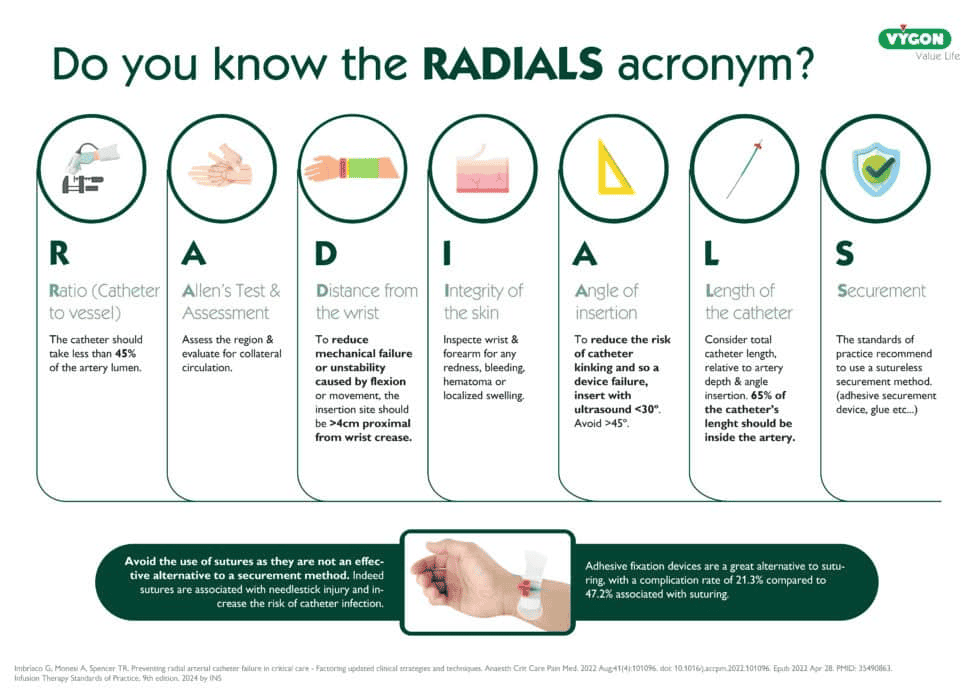
This approach reflects a broader trend in vascular access practice: replacing variability with standardised processes capable of delivering more predictable outcomes.
Why Site Selection Matters
One of the most significant findings from recent research concerns the optimal anatomical location for catheter insertion.
Traditionally, clinicians have targeted the most distal and superficial portion of the radial artery near the radiocarpal crease. However, this location also corresponds to the area of greatest wrist movement.
Current evidence suggests that placing the catheter approximately four centimetres proximal to the wrist crease may reduce complications associated with movement, including dislodgement, kinking, and loss of catheter function. 2, 7
Thanks to ultrasound technology, the slightly deeper position of the artery in this region no longer presents a major technical challenge. Instead, it offers an opportunity to improve catheter longevity and performance.
Preventing Complications Through a Proactive Strategy
Although radial arterial catheterisation is generally regarded as a safe procedure, complications can still occur and occasionally become serious.
Potential adverse events include:
- Hematoma formation
- Radial artery occlusion
- Pseudoaneurysm
- Catheter-related infection
- Digital ischemia
- Nerve injury
- Accidental catheter removal3
Many of these complications share common contributing factors, including multiple puncture attempts, suboptimal site selection, inadequate stabilisation, and insufficient post-insertion monitoring.
For this reason, prevention must begin before the first needle puncture. Comprehensive vascular assessment, evidence-based device selection, and standardised insertion practices should all form part of a comprehensive risk-reduction strategy.
Looking Beyond the Catheter: A System-Level Perspective
The performance of an arterial catheter depends on much more than successful insertion. Accurate haemodynamic monitoring also requires a properly functioning transduction system, correct levelling at the phlebostatic axis, appropriate flush system pressure, a careful interpretation of the arterial waveform.
Similarly, continuous assessment of the insertion site, effective catheter securement, transparent dressing management, and prompt device removal when no longer clinically indicated are all essential components of high-quality care.
In other words, optimal outcomes depend not only on the procedure itself but also on the culture of care surroundings the device throughout its entire lifespan.
The Future of Radial Arterial Catheterization
The future of vascular access in increasingly characterised by image guidance, standardisation, and data-driven clinical practice. The integration of structured protocols, continuous professional education, and advanced securement technologies is helping healthcare organisations reduce complications and improve performance.
Rather than viewing radial arterial catheterisation as a routine procedure, healthcare teams should recognise it as a strategic component of patient safety and vessel preservation programs.
Combining ultrasound assessment, optimal site selection, evidence-based insertion techniques, and meticulous maintenance practices offers a clear opportunity to enhance catheter reliability and maximise clinical value.
In critical care, where every haemodynamic measurement can influence life-saving decisions, reliable arterial access is not merely a technical detail. It is a fundamental contributor to quality care, patient safety, and better clinical outcomes.
REFERENCES
- Scheer B, Perel A, Pfeiffer UJ. Clinical review: complications and risk factors of peripheral arterial catheters used for haemodynamic monitoring in anaesthesia and intensive care medicine. Critical Care. 2002;6(3):199-204.
- Spencer T, Pittiruti D, et al. Evidence-Based Strategies to Prevent Radial Arterial Catheter Failure. Anaesthesia Critical Care & Pain Medicine. 2022.
- Brzezinski M, Luisetti T, London MJ. Radial artery cannulation: a comprehensive review of recent anatomic and physiologic investigations. Anesthesia & Analgesia. 2009;109(6):1763-1781.
- Gu W, Tie H, Liu H, Luo J. Efficacy of ultrasound-guided radial artery catheterization: a systematic review and meta-analysis of randomized controlled trials. Critical Care. 2018;22:197.
- Sharp R, Cummings M, Fielder A, et al. The catheter-to-vessel ratio and risks associated with vascular access devices. Journal of the Association for Vascular Access. 2015.
- Pandurangadu AV, Tucker J, Brackney AR, et al. Relationship between catheter dwell characteristics and device failure in vascular access.
- Spencer T, et al. Arterial Insertion Method (AIM): Optimizing Radial Artery Catheter Placement. Journal of Vascular Access. 2020.
- Pittiruti D, Spencer T, et al. Safe Insertion of Arterial Catheters Bundle: International Consensus Recommendations. Journal of Vascular Access. 2023.

A place to learn about health procedures and techniques from leading professionals.