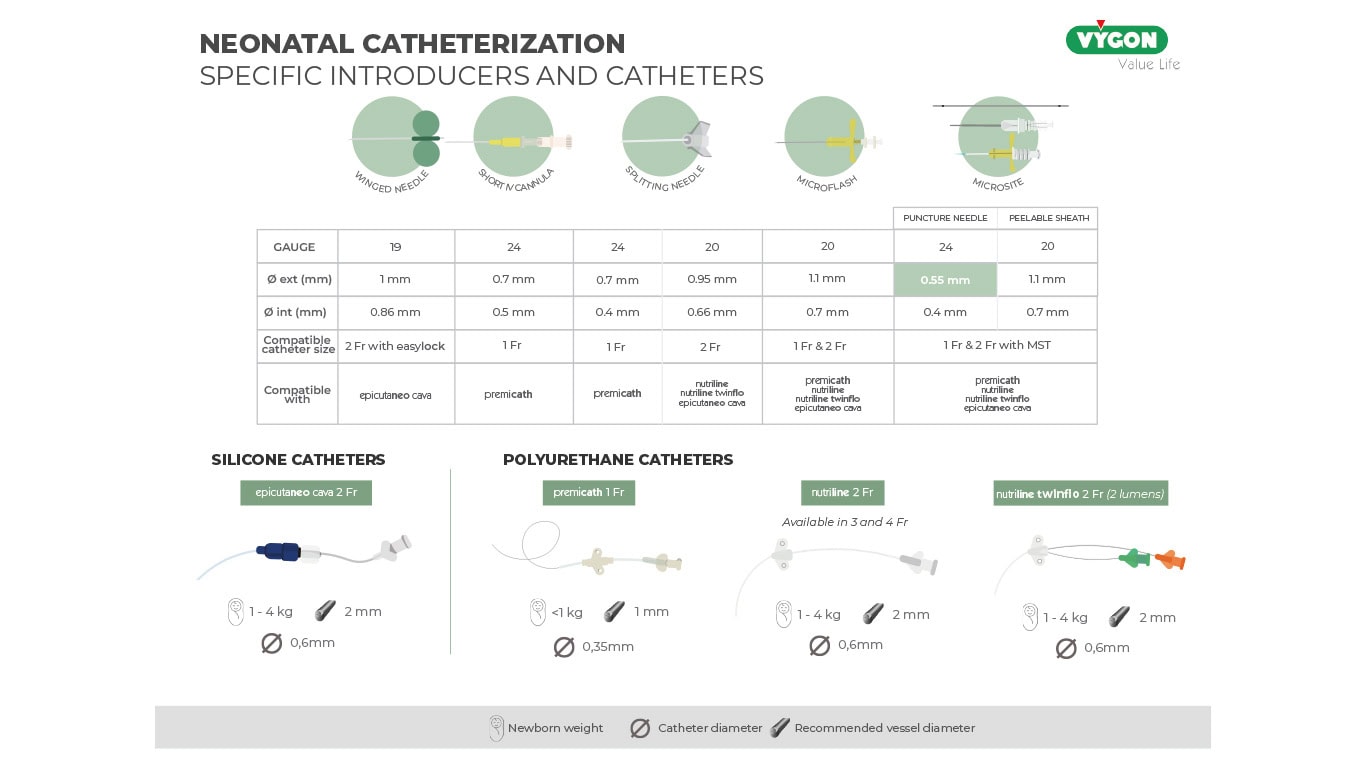
Introducers and specific catheters for neonatal cannulation

Ensuring safe vascular access in neonates requires precision and the correct choice of devices to reduce the risk of infection and complications. This infographic provides a comprehensive technical overview of introducers and specific catheters for neonatal cannulation, offering a vital reference for NICU professionals.

The visual guide details the compatibility between puncture needles—such as splitting needles and short IV cannulas—and specific catheters like premicath and epicutaneo cava. It highlights the clinical benefits of the Modified Seldinger Technique (MST) using microsite introducers to improve first-attempt success rates. Furthermore, it outlines critical safety parameters, including the ideal 33% vein-to-catheter ratio, to ensure optimal flow and preserve the delicate neonatal venous capital.
[Download the full Infographic PDF here]

The image displays a compatibility table for needle gauges (19G to 24G) and their use with silicone and polyurethane neonatal PICC lines (Epicutaneo Cava, Premicath, Nutriline). It includes illustrations of needle types (Winged, Splitting, Short IV) , visual recommendations on the vein-to-catheter ratio (ideal 33%) , use of the Modified Seldinger Technique (MST) , and sutureless fixation guidelines using tissue glue for patients weighing 1-4 kg.
Transforming vascular access in oncology

Transforming vascular access in oncology

A practical manual developed from the VYVAEXPERTS25 conference. Bringing together insights from leading professionals, it explores how proper selection, placement, and management of vascular access devices can optimize treatment effectiveness, patient safety, and...

read more
Share This