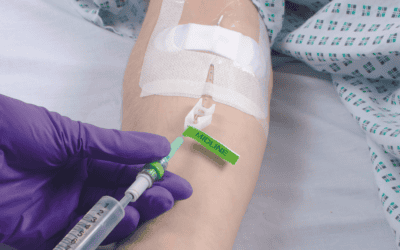

Having explored needle‑free connector design types, the next critical factor to consider is fluid displacement. Although often less visible than external design features, fluid displacement plays a central role in catheter patency, blood reflux, and the risk of occlusion.
Fluid displacement refers to the movement of fluid into or out of the catheter when a syringe or administration set is connected to or disconnected from a needle‑free connector. Even very small volumes of blood reflux can contribute to fibrin build‑up, thrombus formation, and long‑term catheter complications. For this reason, understanding fluid displacement behaviour is an essential part of informed connector selection.1,2,3
Understanding Fluid Displacement
Needle‑free connectors are commonly classified by how they behave at the moment of disconnection. These behaviours are described as negative, positive, or neutral (or anti‑reflux) displacement.
While the terminology may sound straightforward, it is important to recognise that displacement labels do not always fully describe real‑world performance. Actual outcomes depend on internal design, valve mechanisms, and how the device responds to pressure changes during use.1,2
Negative Displacement Connectors
Negative displacement connectors allow a small amount of fluid to be drawn back into the catheter lumen when the syringe or IV set is disconnected. This backward movement can pull blood into the catheter tip if appropriate technique is not used.
To minimise reflux with negative displacement devices, a specific flush – clamp – disconnect sequence is often required. If this sequence is performed incorrectly or inconsistently, the risk of blood reflux, catheter occlusion, and biofilm formation increases.1,3
Negative displacement connectors can perform well when staff are familiar with the required technique and practice is consistent. However, they are more sensitive to human error and variation in clinical practice, particularly in busy environments.

Positive Displacement Connectors
Positive displacement connectors are designed to push a small amount of fluid into the catheter lumen at the point of disconnection. This forward flush is intended to reduce blood reflux at the catheter tip.
In theory, this design helps maintain catheter patency. In practice, however, studies have shown that outcomes vary significantly depending on the specific internal mechanism and how the device is used. Some positive displacement designs still require careful timing of clamping, and incorrect technique can negate the intended benefit.2,4
Clinical evidence shows that infection and occlusion outcomes with positive displacement connectors are inconsistent and highly dependent on the connector’s internal design rather than displacement category alone.2

Neutral (Anti‑Reflux) Displacement Connectors
Neutral displacement connectors are considered more user-friendly as they are designed to produce minimal or no fluid movement into or out of the catheter during connection and disconnection. Many modern devices achieve this using internal pressure‑activated or bidirectional valve technology.
By limiting reflux without relying on a specific clamp sequence, neutral or anti‑reflux connectors aim to reduce technique variability and provide more predictable catheter protection. In vitro studies have demonstrated significantly lower reflux volumes with connectors incorporating anti‑reflux mechanisms compared with devices without such features.5
Neutral displacement connectors are widely used in the UK and are often favoured in settings where consistency of practice and reduction of human error are key priorities.3,5

Negative vs. Neutral Connectors
| Feature | Negative Displacement | Neutral Displacement |
| Fluid Movement | Backward movement (reflux) during disconnection | Minimal to no fluid movement |
| Technique Sensitivity | High – requires specific clamp sequence | Lower – more simple operation |
| Risk of Reflux | Increased | Decreased but varies by design |
| CLABSI Impact | Mixed evidence, varies by product | Mixed evidence, varies by product |
| Best Use Case | Environments with strong adherence to flushing protocols | Settings with varied staff skill or workflow complexity |
Why Fluid Displacement Is a Key Selection Criterion
The evidence shows that internal microbial contamination and occlusion events vary by device design, but negative displacement systems may allow more blood reflux compared to designs with anti-reflux technology.6 Whereas, central line associated bloodstream infection (CLABSI) rates vary widely among neutral and negative devices, indicating performance differences depend heavily on connector engineering rather than displacement category alone.7
Blood reflux, even in very small volumes, is a major contributor to catheter occlusion and loss of line function. Evidence shows a clear relationship between connector fluid displacement behaviour, reflux volume, and occlusion risk.1,5
Displacement choice also affects:
- Technique requirements, including flushing and clamping sequences
- Reliability of aspiration
- Staff training needs
- Suitability for high‑risk patients and long‑term vascular access
Connectors that rely heavily on precise technique may perform well in controlled environments but can increase risk where practice varies. Devices that minimise reflux by design may offer greater protection where multiple clinicians access the same catheter or where long dwell times are expected.1,2,3
Putting Displacement into Clinical Context
Fluid displacement should never be considered in isolation.
The safest choice depends on how displacement behaviour aligns with:
- Clinical environment
- Staff familiarity and training
- Frequency of line access
- Patient acuity and catheter dwell time
Understanding displacement options allows clinicians and organisations to select connectors that support consistent practice, reduce avoidable complications, and maintain catheter patency over time.
Conclusion
Negative and neutral needle‑free connectors each offer benefits and limitations. The most important takeaway for clinical practice is reinforced across multiple studies, that connector design quality and correct usage practices matter more than displacement category alone.
Next in this Series
This section has focused on how fluid displacement affects blood reflux and catheter performance. In the next section, we will explore reflux prevention and occlusion management, examining how connector technology, valves, and pressure changes interact to protect the catheter tip and support long‑term vascular access.
References
- Moureau N, Gorski L, Flynn J, Johnson K. A systematic review of needleless connector function and occlusion outcomes. J Infus Nurs. 2025;48(2):84–105.
- Rosenthal VD. Clinical impact of needle‑free connector design: a systematic review of literature. J Vasc Access. 2020;21(6):847–853.
- O’Grady NP, Alexander M, Burns LA, et al. Guidelines for the prevention of intravascular catheter‑related infections. Clin Infect Dis. 2011;52(9):e162–e193.
- Btaiche IF, Kovacevich DS, Khalidi N, Papke LF. The effects of needleless connectors on catheter‑related bloodstream infections. Am J Infect Control. 2011;39(4):277–283.
- Hughey J, Gibson MS, Moureau N, Buzas B. An in vitro evaluation of needleless connectors with and without anti‑reflux technology. Int J Nurs Health Care Res. 2023;6:1439.
- Hughey J, Gibson SM, Moureau N, Buzas B. An in vitro evaluation and comparison of commercially available needleless connectors with and without anti‑reflux technology. Int J Nurs Health Care Res. 2023;6:1439. doi:10.29011/2688-9501.101439. Available from: https://www.gavinpublishers.com/article/view/an-in-vitro-evaluation-and-comparison-of–commercially-available-needleless-connectors-with-and-without-anti-reflux-technology
- Rosenthal VD. Clinical impact of needle‑free connector design: a systematic review of literature. J Vasc Access. 2020;21(6):847‑853. doi:10.1177/1129729820904904. Available from: https://inicc.org/site/wp-content/uploads/2023/04/366.pdf
Safety and Disinfection – Preventing Contamination

A place to learn about health procedures and techniques from leading professionals.