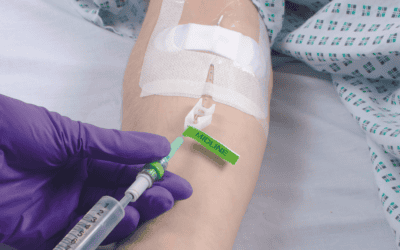

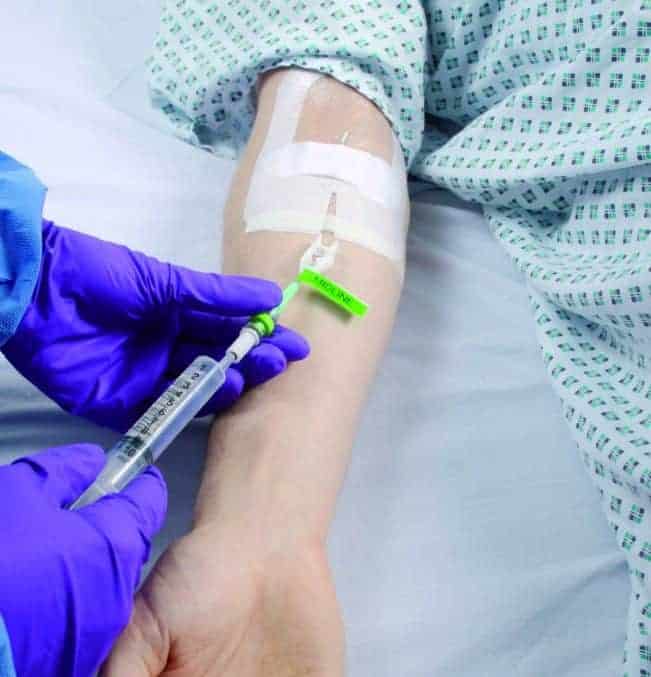
Needle‑free connectors are the most frequently accessed part of a vascular access device. Each access event presents an opportunity for microorganisms to enter the catheter lumen, making the connector a primary control point for contamination and infection prevention.
While connector design and fluid displacement influence reflux and occlusion, safety and disinfection practices determine how well a connector performs as a microbial barrier. Preventing contamination relies on three closely linked factors: evidence that the device resists microbial ingress, effective disinfection of the access surface, and design features that reduce biofilm formation.
Understanding these elements is essential to reducing catheter‑related bloodstream infections (CRBSIs) and maintaining long‑term catheter integrity.1,2,3
Microbial Ingress Testing: Demonstrating Barrier Performance
Microbial ingress testing provides evidence of a connector’s ability to prevent microorganisms from entering the fluid pathway under simulated clinical conditions. This testing evaluates whether bacteria can migrate through the connector during repeated access, disinfection, and flushing cycles.
Guidance from infection‑prevention experts emphasises that needle‑free connectors should be supported by robust microbial ingress data, rather than relying on design claims alone.1,2 Devices that demonstrate resistance to microbial penetration are better suited to maintaining a closed system throughout the catheter dwell time.
Without this evidence, it is difficult to assess how a connector will perform in real‑world use, particularly when subjected to frequent access, variable technique, or long‑term therapy. For this reason, microbial ingress testing is regarded as a key selection criterion when evaluating connector safety.2,3
Device and Septum Disinfection: The Importance of Access Surface Design
Effective disinfection of the connector septum is a cornerstone of infection prevention. The catheter hub and connector are recognised as major routes for intraluminal contamination, especially in catheters with longer dwell times.3
Guidelines consistently recommend scrubbing the access point with 70% isopropyl alcohol or alcohol‑based solutions containing chlorhexidine, using appropriate friction and allowing adequate drying time before access.3,4 However, the effectiveness of disinfection is strongly influenced by connector design.
Connectors with a flat, smooth, gap‑free septum surface are easier to disinfect thoroughly. In contrast, recessed features, grooves, or irregular surfaces may harbour microorganisms and increase the risk of incomplete cleaning. Studies have shown that variability in access surface design can directly affect disinfection reliability, particularly under time pressure or with inconsistent technique.1,5
In addition to active disinfection, evidence supports the use of passive disinfection caps, which provide continuous antiseptic protection between accesses and reduce reliance on human technique. These devices have been associated with reductions in hub contamination and CRBSI rates in multiple clinical settings.6,7
Biofilm Reduction: Addressing Contamination Beyond the Surface
Even when septum disinfection is performed correctly, microorganisms that enter the connector can adhere to internal surfaces and form biofilm. Once established, biofilm provides protection for bacteria and makes eradication significantly more difficult.
Connector design plays a critical role in biofilm risk.
Factors associated with lower biofilm formation include:
- Straight, direct internal fluid pathways
- Minimal dead space
- Fewer internal surfaces
- Absence of complex moving parts1,2
Mechanical complexity within the connector can create areas of low flow or stagnation, where blood or drug residue may remain and support microbial growth. Over time, this can lead to persistent contamination, catheter‑related infection, or occlusion.
Reducing biofilm risk therefore depends on a combination of simple internal design, effective flushing, and consistent disinfection practices. Design choices that minimise biofilm formation support safer long‑term catheter use, particularly in patients requiring prolonged or frequent vascular access.2,5
Bringing Safety, Disinfection, and Design Together
Preventing contamination is not achieved through a single intervention, but through alignment between device design, evidence‑based safety testing, and everyday clinical practice.
Connectors that demonstrate resistance to microbial ingress, support effective septum disinfection, and minimise biofilm formation provide a stronger foundation for infection prevention. When combined with education and standardised practice, these features reduce avoidable complications and help maintain catheter function over time.
Reducing Contamination Risk Through Aseptic Practice
These practices align directly with the principles of Aseptic Non-Touch Technique (ANTT®), which emphasise protecting key parts and key sites from contamination during vascular access procedures. Needle‑free connectors are a critical key part within ANTT®, as they form the direct interface between the clinical environment and the intraluminal pathway. Connector designs that support effective disinfection and reduce reliance on complex handling help clinicians apply ANTT® principles more consistently in everyday practice.4 It is also important to use appropriate and thorough handwashing techniques, within ANTT®.
Conclusion: Designing for Safer Access
Preventing contamination at the point of access requires more than good technique alone. Needle‑free connectors sit at the centre of vascular access safety, and their ability to protect the intraluminal pathway depends on a combination of evidence‑based design, effective disinfection, and consistent clinical practice.
Connectors that demonstrate resistance to microbial ingress, support thorough septum disinfection, and minimise opportunities for biofilm formation provide a stronger foundation for infection prevention. When these design features align with aseptic principles, such as those underpinning ANTT®, they help reduce reliance on perfect technique and make safe practice easier to achieve in everyday clinical environments.
Ultimately, safety and disinfection are not achieved through a single intervention, but through thoughtful selection of devices that support clinicians in protecting patients from avoidable risk. By understanding how connector design influences contamination, healthcare teams can make informed choices that improve reliability, reduce complications, and support safer vascular access care over the full catheter dwell time.
Next in the Series
This article has focused on safety and disinfection as key elements in preventing contamination associated with needle‑free connectors. In the next article, we will explore reflux prevention and catheter occlusion, examining how valve technology and pressure management contribute to maintaining catheter patency and therapy continuity.
References
1. Rosenthal VD. Clinical impact of needle‑free connector design: a systematic review of literature. J Vasc Access. 2020;21(6):847–853.
2. Jarvis WR. Choosing the best design for intravenous needleless connectors to prevent bloodstream infection. Infect Control Today. 2010;14(7).
3. O’Grady NP, Alexander M, Burns LA, et al. Guidelines for the prevention of intravascular catheter‑related infections. Clin Infect Dis. 2011;52(9):e162–e193.
4. Loveday HP, Wilson JA, Pratt RJ, et al. epic3: national evidence‑based guidelines for preventing healthcare‑associated infections in NHS hospitals. J Hosp Infect. 2014;86(S1):S1–S70.
5. Btaiche IF, Kovacevich DS, Khalidi N, Papke LF. The effects of needleless connectors on catheter‑related bloodstream infections. Am J Infect Control. 2011;39(4):277–283.
6. Sweet MA, Cumpston A, Briggs F, Craig M, Hamadani M. Impact of alcohol‑impregnated port protectors and needleless connectors on central line–associated bloodstream infections. Am J Infect Control. 2012;40(10):931–934.
7. Wright MO, Tropp J, Schora DM, et al. Continuous passive disinfection of catheter hubs prevents contamination and bloodstream infection. Am J Infect Control. 2013;41(1):33–38.
Mechanical and Clinical Considerations in Device Selection

A place to learn about health procedures and techniques from leading professionals.