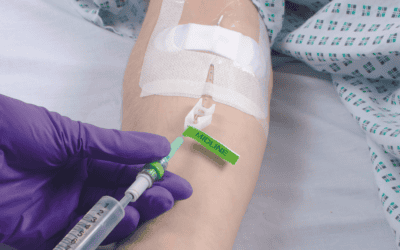

Throughout this article series, we have explored what needle‑free connectors are, how they differ in design and function, and why factors such as fluid displacement, disinfection, and standardisation matter. At the centre of all these considerations is a simple but critical question: how does connector choice affect patients and the healthcare professionals who care for them?
Choosing the right needle‑free connector is not just a technical or procurement decision. It directly influences patient experience, clinical safety, staff workload, and the reliability of everyday vascular access care.1,2,3
Patient Benefits of Choosing the Right Connector
For patients, the impact of connector choice is most clearly seen in catheter performance, infection risk, and continuity of therapy.
A well‑selected needle‑free connector helps maintain catheter patency by reducing blood reflux into the catheter lumen. This lowers the risk of fibrin build‑up, thrombus formation, and both partial and total occlusions. Fewer occlusions mean fewer interruptions to treatment and a reduced need for catheter replacement or thrombolytic interventions.1,4
Infection prevention is another key patient benefit. Needle‑free connectors that support effective disinfection, demonstrate resistance to microbial ingress, and minimise internal biofilm formation help reduce the risk of catheter‑related bloodstream infections (CRBSIs). These infections are associated with increased morbidity, longer hospital stays, and higher healthcare costs. Selecting connectors that support a closed, contamination‑resistant system contributes directly to safer patient outcomes.2,3
Patients requiring long‑term or high‑frequency vascular access, such as those in critical care, oncology, or receiving parenteral nutrition, benefit particularly from consistent connector performance. Reliable aspiration, predictable flushing, and reduced manipulation of the catheter hub all help preserve line integrity over time and improve comfort and confidence for the patient.1,2
Ultimately, the right connector helps ensure that therapy is delivered as intended, without unnecessary delays, complications, or repeated invasive procedures.
Staff Benefits of Choosing the Right Connector
For healthcare professionals, connector choice has a significant impact on workflow efficiency, safety, and confidence in practice.
Connectors that are easy to understand and consistent in their behaviour reduce reliance on complex flushing or clamping sequences. This lowers cognitive burden and decreases the likelihood of technique‑related errors, particularly in busy clinical environments or where staff rotation is high.1,3
Standardising a single connector type within a clinical area further supports staff by reducing variation in practice. When connectors behave predictably, education becomes more effective, skills are reinforced through repetition, and teams are better able to deliver safe, consistent care across shifts.3,5
Staff safety is also improved through the use of needle‑free connectors that eliminate the need for sharps during routine IV access. Reducing needlestick injuries protects healthcare workers from blood‑borne pathogen exposure and supports a safer working environment.2,3
Additionally, devices with good ergonomic design, clear visibility, and straightforward access surfaces save time during connection, disinfection, and flushing. Over the course of a shift, these seemingly small efficiencies can significantly improve workload management and reduce frustration associated with troubleshooting occluded or unreliable lines.1,5
Bringing Everything Together
Throughout this series, we have seen that needle‑free connectors play a far greater role in vascular access safety than their size might suggest. Connector design, fluid displacement behaviour, disinfection, mechanical performance, and compatibility all interact with human factors and clinical workflows.
No single feature defines the “best” connector. Instead, the safest choice is one that:
- Aligns with clinical practice and environment
- Minimises reliance on perfect technique
- Supports effective disinfection and reflux prevention
- Integrates seamlessly with the wider IV system
- Can be standardised and taught consistently1,2,3,5
When these elements are aligned, the benefits are clear. Patients experience fewer complications and interruptions to care. Staff work with greater confidence, consistency, and safety. Healthcare organisations reduce avoidable risk and support more reliable vascular access outcomes.
By understanding needle‑free connectors not just as devices, but as integral components of patient safety systems, clinicians and organisations can make informed decisions that improve care for everyone involved.
References
- Rosenthal VD. Clinical impact of needle‑free connector design: a systematic review of literature. J Vasc Access. 2020;21(6):847–853.
- O’Grady NP, Alexander M, Burns LA, et al. Guidelines for the prevention of intravascular catheter‑related infections. Clin Infect Dis. 2011;52(9):e162–e193.
- Infusion Nurses Society. Infusion therapy standards of practice. J Infus Nurs. 2021;44(Suppl 1):S1–S224.
- Moureau N, Gorski L, Flynn J, Johnson K. Needleless connector function and occlusion outcomes. J Infus Nurs. 2025;48(2):84–105.
- Loveday HP, Wilson JA, Pratt RJ, et al. epic3: national evidence‑based guidelines for preventing healthcare‑associated infections in NHS hospitals. J Hosp Infect. 2014;86(S1):S1–S70.

A place to learn about health procedures and techniques from leading professionals.