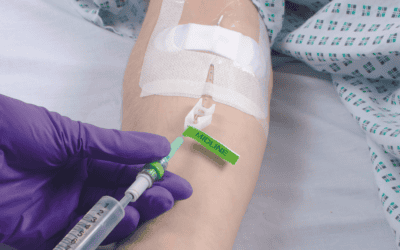

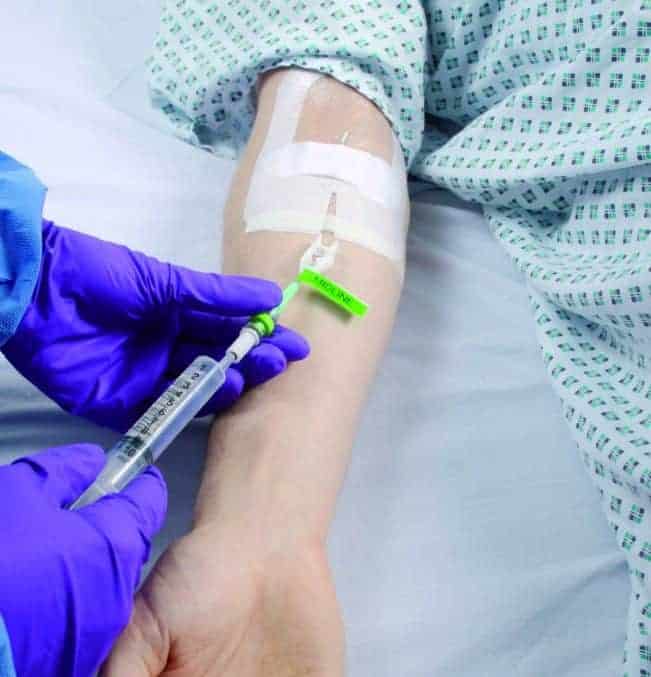
Selecting a needle‑free connector is not simply a matter of choosing between split septum or mechanical valve designs, or between different fluid displacement categories. In everyday clinical practice, mechanical behaviour, workflow compatibility, and usability all play a critical role in how safely and reliably a device performs.
A connector that is well designed on paper may still contribute to complications if it does not align with clinical workflows, staff training, or the wider IV system. Understanding these mechanical and clinical considerations supports safer selection, effective standardisation, and improved outcomes for both patients and healthcare professionals.1,2,3
Sequence Sensitivity and the Need for Standardisation
Some needle‑free connectors require a specific flushing, clamping, and disconnection sequence to minimise blood reflux into the catheter lumen. If this sequence is not followed correctly, even momentary backflow can occur, increasing the risk of fibrin deposition, thrombus formation, and catheter occlusion.1,4
Devices that are sensitive to technique place greater reliance on:
- Consistent staff training
- Clear local protocols
- Standardised use across clinical areas
Where multiple connector types are used within the same environment, variation in required technique can lead to confusion and inconsistent practice. This increases the likelihood of human error, particularly in busy settings or where staff rotation is high. For this reason, many guidelines recommend standardising connector type to reduce variability and improve reliability of care.3,5
Connectors that minimise reflux by design, without relying on precise sequencing, may offer advantages in environments where consistency is challenging to maintain.
Device Design and Ergonomics in Everyday Use
Beyond internal mechanics, the external design and ergonomics of a connector influence how easily it can be accessed, disinfected, and flushed.
Key ergonomic considerations include:
- A flat, smooth septum that supports effective disinfection
- Clear visual cues that confirm correct connection
- A transparent housing that allows inspection for residue or blood
- A compact profile that reduces snagging or leverage on the catheter hub1,2
Devices that are intuitive to use and easy to handle are more likely to be used correctly, particularly during high‑pressure clinical situations. Conversely, complex or poorly visible designs can increase handling time and the risk of improper access or incomplete flushing.1
Compatibility With Drugs and IV Components
Compatibility is a critical but sometimes overlooked aspect of connector selection. Needle‑free connectors must integrate seamlessly with infusion sets, extension lines, pumps, and syringe systems, while also supporting the safe administration of prescribed therapies.
Key compatibility considerations include:
- Resistance to drug adsorption or absorption
- Suitability for high‑pressure applications, such as syringe pumps or CT injectors
- Compatibility with lipid‑based medications and parenteral nutrition
- Secure Luer connections to prevent leaks or disconnection2,6
Materials used within connectors can affect drug delivery accuracy, particularly for medications with narrow therapeutic ranges or long dwell times. Device selection should therefore account for manufacturers’ drug compatibility information and the clinical context in which the connector will be used.2,6
Benefits for Patients and Healthcare Professionals
When mechanical behaviour, usability, and compatibility are aligned with clinical practice, needle‑free connectors deliver clear benefits for both patients and staff.
For patients, appropriate device selection can result in:
- Reduced risk of catheter occlusion and replacement
- Fewer therapy interruptions
- Lower infection risk
- Improved long‑term catheter function and comfort1,2,3
For healthcare professionals, well‑matched devices support:
- Simpler, more consistent workflows
- Reduced cognitive load and reliance on complex sequences
- Lower risk of needlestick injuries
- Increased confidence in everyday catheter management2,3
Ultimately, selecting a connector that fits the clinical environment improves safety not by adding complexity, but by removing unnecessary opportunities for error.
Bringing Mechanical and Clinical Factors Together
The most effective needle‑free connector is not defined by a single feature, but by how well it integrates into real‑world clinical practice. Mechanical behaviour, ergonomics, compatibility, and training requirements must all be considered together.
By selecting devices that support standardised practice, are easy to disinfect and use, and align with local workflows, healthcare organisations can reduce avoidable complications and support safer, more reliable vascular access care.
Next in the Series
This article has explored the practical mechanical and clinical considerations involved in needle‑free connector selection. In the next article, we will focus on patient and staff outcomes, examining how connector choice influences safety, efficiency, and experience across the care pathway.
References
1. Rosenthal VD. Clinical impact of needle‑free connector design: a systematic review of literature. J Vasc Access. 2020;21(6):847–853.
2. Munoz‑Mozas G. Needle‑free devices: design, function, benefits and possible complications. Br J Nurs. 2025;34(20).
3. O’Grady NP, Alexander M, Burns LA, et al. Guidelines for the prevention of intravascular catheter‑related infections. Clin Infect Dis. 2011;52(9):e162–e193.
4. Moureau N, Gorski L, Flynn J, Johnson K. Needleless connector function and occlusion outcomes. J Infus Nurs. 2025;48(2):84–105.
5. Infusion Nurses Society. Infusion therapy standards of practice. J Infus Nurs. 2021;44(Suppl 1):S1–S224.
6. Loveday HP, Wilson JA, Pratt RJ, et al. epic3: national evidence‑based guidelines for preventing healthcare‑associated infections. J Hosp Infect. 2014;86(S1):S1–S70.
Patient and Staff Benefits of Choosing the Right Connector

A place to learn about health procedures and techniques from leading professionals.